

Battling grubs, again
and probably again and again

I did it again.
Last week, during one of those grey soaking rains we’ve been having, I moved a pot of brugmansia to check the drainage hole and something moved. Not one something. Many somethings. A pale, dense cluster of white grubs had gathered in the damp space beneath the container, tight and writhing, and I just stood there in the rain looking at them. I have never felt the word infestation quite so physically before.
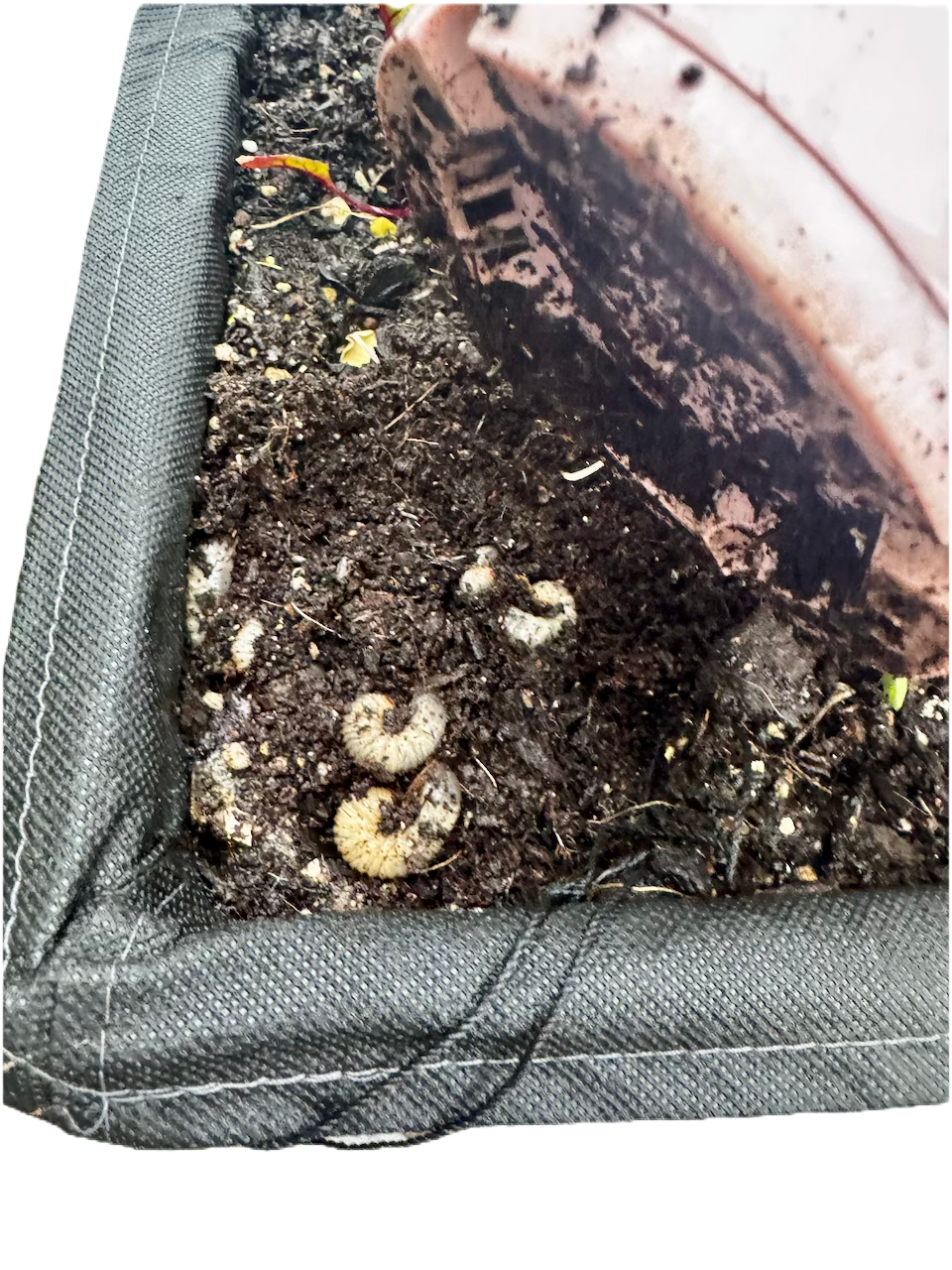
That was just one pot. The medium-sized VegTrug I use for brassicas was worse — absolutely full of them, the soil practically animated when I turned it out. I tried hand removal first, which works fine until you have forty containers packed tightly together and roots threading through everything. At some point I accepted that I wasn’t going to pick my way out of this.
I am reluctant to write this, but I feel it’s best to grapple with the reality of container gardening AND local limitations on “safe” pest control. I used diazinon again this spring. I am not proud of this. There is no nematode option here, no envelope of predatory insects to order online, no “biological solution” waiting at Cainz. Japan has not made this easy for the person who would very much like to feel righteous about their balcony. I hate that I had to use a poison in my garden, and it was heartbreaking to remove all the flowering parts beforehand so as not to harm pollinators. But the scale of it had explained something I’d been puzzling over all winter: why things hadn’t quite picked up the way they usually do as the sun angle changes. The roots had been getting eaten alive while I was blaming the weather.
The effect was fast and, I’ll admit, satisfying in a way I felt conflicted about. The amount I used was almost implausibly small, like a sprinkling that wouldn’t be enough to salt a nice steak. Within a couple of days, dying grubs were surfacing everywhere. Within nineteen days, the chard and collards look stunning, fat and huge, and the snap peas have been almost too productive. The plants had simply been fighting an underground war I couldn’t see.
I want to address the obvious concern, because I had it too. The reassuring context, after some research, is that this is a soil incorporation treatment, not a foliar spray — and that distinction matters enormously for the vegetables I’m growing in these containers. Diazinon applied as granules into soil does not move efficiently into above-ground plant tissues. The 30-day harvest interval on the label exists primarily for root vegetables, where uptake through the roots is more direct, and for foliar applications, which are a different and higher-residue situation entirely. For eggplant, tomato, cucumber, pepper, all listed on the label, the margin is very wide. Good thing I used fresh soil for the potatoes anyway, though they’re nowhere near ready regardless.
Japan’s Food Safety Commission (食品安全委員会) sets the ADI for diazinon at 0.001 mg/kg body weight/day, meaning a 70 kg adult’s safe daily threshold is 0.07 mg. At typical soil-application residue levels on fruiting vegetables, you would need to eat an implausible quantity of produce to approach that threshold within the PHI window.
I also felt guilt about the earthworms that had found their way into some containers, but I’ve come to think that’s misplaced sentiment. My raised fabric containers on a hard balcony surface are closed systems; worms that wander in have nowhere to go when things get too wet, too dry, or - and Tokyo does get very hot - simply too hostile. They tend not to survive long in this environment regardless. It’s fundamentally different from treating an in-ground bed.
The broader ecological guilt took a bit more talking myself down from. I’d been absorbing all the usual, entirely valid anxiety about collapsing insect populations. But these beetles, the big brown chafers you find everywhere in urban Japan, are one of the most common insects in the city. Parks, street trees, roadside planters, every patch of soil in Tokyo is full of them. Removing a few dozen from my containers makes no ecological dent. Their role in decomposing organic matter and feeding birds plays out perfectly well in every green space within a five-minute walk. In a container, they’re simply in the wrong place: a closed system with no natural predators, a finite root zone, and no capacity to absorb the damage. In open ground a plant might lose some roots to grubs and compensate; in a pot, a handful of third-instar larvae can consume the entire root mass before anything shows above ground.
I try to remember that the balcony itself is a net positive. Flowering plants feeding adult beetles, bees, pollinators. The odd grub I remove by hand, tossed over the railing onto the roof below, feeds a crow within about four minutes. I’m participating in the food web, just on my own terms, in an artificial system, making the judgment calls that system requires.
And my compost bin is still absolutely crawling with the buggers.
What a difficult and challenging situation for you. I feel for you. I had a plague of rats a couple of years ago and felt similar disheartened. I’m sorry you can’t get hold on an appropriate nematode. This looks similar (but larger) to the vine weevil we get in the UK - and there is a nematode control we can buy which is reasonably effective. Do any birds visit your balcony? If so, one option (although I appreciate a lot of work), might be to spread out the soil in your pots on a tarpaulin or similar, and let the birds pick them out. This also works quite well for vine weevil in the UK - although blackbirds also eat the worms at the same time! Just a thought. Good luck - and glad to hear things are growing well now.