

Irrigation Irritation
Container gardening is a lot different than dirt farming

This will be a long one today, folks… I’m doing an American Horticultural Society course on Ecological Gardening. The current module I’m on is “Prevention & Conservation.” If you garden in containers, “Dealing with Drought” by Nan Sterman in The American Gardener is a great article that… mostly isn’t talking to you. It’s written for people with actual ground, and a lot of its best ideas either don’t translate to containers or go sideways once there’s a drainage hole involved.
Here’s what I’d push back on from a balcony / container point of view.
Big irrigation systems for tiny pots
A huge chunk of the article is about “efficient irrigation technology”: in‑line drip tubing, soaker hoses, and smart controllers that run multiple zones on custom schedules.
That’s fantastic if you have a yard.
On a balcony with nine pots and a suspicious landlord? Not so much.
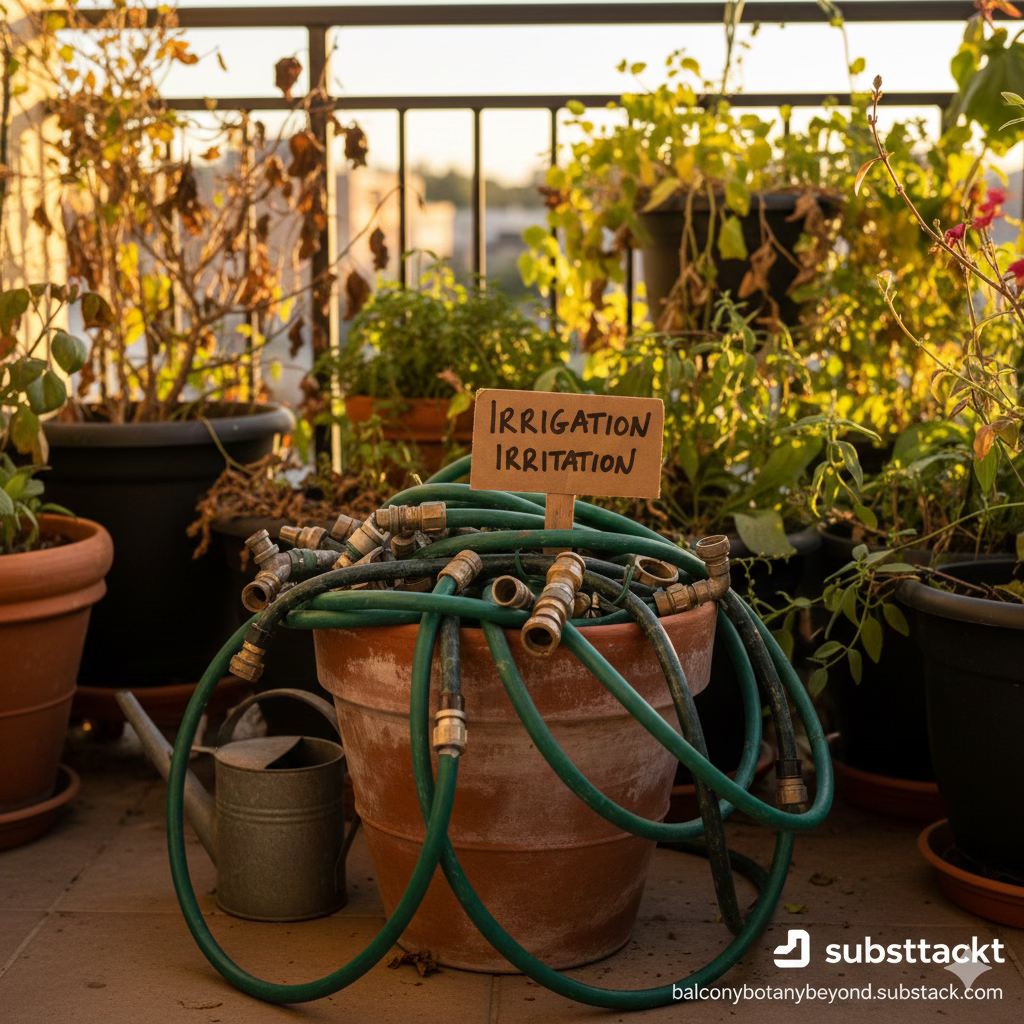
• In‑line drip tubing is designed to wet a broad root zone in the ground, not a 12‑inch pot. The emitters are spaced every 6–12 inches to create an even blanket of moisture in a planting bed. In a container, that turns into one awkward loop across the soil surface that you’re constantly bumping, tangling, and cursing at. I should know, I tried it.
• Soaker hoses are meant to snake through borders, not coil like a garden python inside a 16‑inch planter. They also release more water at the front than the end and clog easily in hard water. In a pot, that just means “muddy side / dry side” in a very small space.
Most container gardeners do better with:
• A watering can or hose wand and a 2‑minute daily check‑in in hot weather.
• If you really want automation, a simple battery timer plus drip stakes/tubing sized for pots—very different hardware than what’s described in the article. It’s what I’ve ended up with after much trial, error, and tears.
The whole irrigation‑zones‑and‑controllers universe is overkill for a balcony. It assumes you can install permanent hardware and that plants stay in one place for years. Containers move. A lot.
“Deep and infrequent” watering… is how you kill pots
The article repeats the classic advice: water “deeply and infrequently” and wait until the soil dries “a couple inches” below the surface before watering again. That makes sense in real soil, where you have several feet of depth to work with and water can bank down below.
Containers are basically the opposite:
• Same root depth as in the ground, but with the sides and bottom exposed to hot air and wind.
• Way less thermal mass.
• Potting mix that’s often fast‑draining and peat or coir‑based (the brits just go ballistic about peat, don’t they?).
If you wait until the top couple of inches are dry in a 10–12 inch pot in full sun, there’s a decent chance the entire root ball is dry, especially in summer. Once peat‑heavy mixes go bone dry, the water you pour in tends to race down the edges and out the bottom, leaving a hydrophobic clump in the middle. I nearly killed my precious Meyer lemon tree this summer, letting the poor thing dry out too much. I had to soak the whole thing in a tub overnight to get him to drink again!
“Deep and infrequent” in a bed = strong roots.
“Deep and infrequent” in a black plastic pot on concrete in August = crispy basil. Delicious, but not productive.
With containers, the drought‑resilient pattern is usually:
• Water thoroughly (until it runs out the drainage hole).
• Check often, water again before the mix fully dries—sometimes daily or twice daily in heat, especially for small pots.
The principle of avoiding constant shallow sips still holds. The timing doesn’t.
Hydrozones don’t work when everything shares one pot
Sterman suggests grouping plants by water needs into “hydrozones” so each zone can be irrigated differently. That’s smart design for a yard: put the thirsty stuff near the hose, keep the tough natives on the far side, etc.
But in containers, we do this very non‑textbook thing: we plant a sun annual, a trailing plant, a filler grass, and maybe a herb, all in the same pot. Their water needs are not the same. Their roots are literally touching.
You can’t:
• Put your “high water” plants on one irrigation zone.
• Your “low water” plants on another.
They’re in one shared soil volume. One watering schedule. One fate.
For container gardeners, the real version of “hydrozoning” is:
• Don’t mix plants with wildly different water needs in the same pot (looking at you, rosemary + petunias).
• Group pots with similar needs together, so when you grab the watering can you’re not trying to remember, “Wait, is this the drought‑tolerant corner or the needy corner?”
Nice idea in the article, but the implementation looks very different on a balcony.
Soil microbiomes and the fantasy of permanence
The article spends time on “cultivating the soil microbiome,” saying not to till, just top‑dress with compost and let worms and soil organisms pull it down over time. It’s a very in‑ground, long‑term view of soil: you’re stewarding the same earth for years or decades.
Container mixes live shorter, messier lives:
• You often start with a sterile or soilless potting mix, such as peat or coir, perlite, bark, rather than actual mineral soil.
• You might dump and refresh that mix every 1–3 years as roots fill the pot and the structure collapses.
There is a microbiome in containers, especially if you reuse mix and add compost, but that “don’t disturb, just mulch and wait for worms to incorporate it over months” model is optimistic when the whole pot might be taken apart next spring.
For containers, what helps more is:
• Mixing in compost or worm castings thoroughly at planting time.
• Maybe doing light top‑dressing during the season.
• Accepting that this is more crop rotation than forever‑soil.
Same underlying idea (healthy biology = better drought resilience), but the article’s practice assumes an actual ground that isn’t going to be dumped in a wheelbarrow every other year.
Catching and storing rain… that you don’t actually get
Sterman talks about “catch and hold” strategies: swales, dips, permeable paving, banking water in the soil, and collecting roof runoff into cisterns to irrigate between storms.
In a yard, that’s smart. In a third‑floor walk‑up with east‑facing railings:
• You can’t dig swales.
• You don’t control the roof.
• Your landlord has Very Strong Feelings about anything that looks like “water storage.”
A few specific misfits:
• Using contours and swales to hold water on site makes sense at ground level; on a balcony, standing water is a structural and safety issue, and usually explicitly forbidden. And don’t forget mosquitoes…
• Big cistern systems are heavy. Water is about 8.3 pounds per gallon. A 100‑gallon tank is ~830 pounds before you add the tank itself. Most balconies are not signing up for that.
For container people, “catch and hold” usually looks more like:
• One modest rain barrel if your building and climate allow, or
• A bucket under the one place your gutter regularly overflows, or
• Just accepting that you, personally, are the irrigation system.
The concept—use free rain first—is great. The earthworks aren’t.
Mulch: 3–4 inches is way too much in a pot
Oh, mulch. Everyone talks about you so much, ranting and raving, but I still am just not that into you. The article recommends a 3–4 inch layer of mulch over the soil to suppress weeds, buffer temperature, and slow evaporation. In beds, that’s standard and helpful.
In containers, a mulch blanket that thick can cause problems:
• It eats into already limited root space in small pots.
• It can bury the crown of low‑growing plants and hold moisture against stems.
• It makes it harder to judge actual soil moisture without constantly digging around.
For pots, especially small to medium ones, a 0.5–1 inch layer of fine bark, shredded leaves, or even a light gravel top is usually enough to slow evaporation without suffocating everything.
The article also mentions inorganic mulches like rock and decomposed granite, especially for succulents, noting that water condenses on rock surfaces and trickles down. That is true in the ground. In a small container on a hot, reflective surface, a thick layer of dark rock can turn the soil into an oven.
If you’ve ever picked up a little black plastic pot with black rock mulch after 3 pm in July, you know that feeling. Your plant knows it too.
The subtle “no fertilizer” message
One more thing that’s easy to mis‑apply: the piece suggests you “don’t fertilize” because fertilizer pushes faster growth, which needs more water. That’s fair for established, in‑ground drought‑resilient plantings where the goal is stability and low inputs.
Containers are artificially cramped and watered more often; nutrients wash out faster. Most potting mixes don’t have long‑term nutrition built in. If you strictly “just say no” to fertilizer in pots, you often end up with:
• Hungry, pale plants.
• Stressed roots that are actually less drought‑tolerant.
Container‑friendly version:
• Skip heavy, high‑nitrogen blasts.
• Use gentle, slow‑release or diluted liquid feeds.
• Aim for “not starving” rather than “lush jungle.”
The core idea, don’t force plants to grow faster than your water budget can support, is still solid. It just needs adjusting when the plant’s entire universe is 14 inches wide.
So yes, “Dealing with Drought” is useful, thoughtful, and written from real experience. It’s just speaking ground‑garden. If you’re gardening in containers, you almost have to mentally run each tip through a “but what if this plant lived in a bucket” filter.
Different world. Same sun. Same dry spells. Very different physics.
The hydrophobic peat mix problem is so real. I lost a couple tomato plants last summer exactly how you described, pouring water in and watching it just channle down the sides. The overnight soak fix worked for me too but felt like borderline plant CPR at that point. The deep-and-infrequent advice being backwards for containers makes total sense when you think about thermal mass and exposed sides. Ground soil is insulated from below, pots aren't. Also completely agree about the 3-4 inch mulch recommendation, that would literally bury half my herbs.